Two very different data sources, one Major TOM grid:
GOES-19 ABI — geostationary weather imager (channel C07, 2025-12-25 15:00 UTC — a stormy day over Córdoba), via the
aereo-search-aws-goes+aereo-read-satpyplugins. Native resolution ~2 km.CHIRPS daily precipitation — a climate dataset, via the third-party
aereo-earthlensplugin (a wrapper around earthlens, ~48 weather/climate providers). Native resolution ~5 km. No credentials needed. We pull the week ending 2025-12-25 and accumulate it — a single day’s rain map is mostly zeros (dry), while the weekly accumulation shows the full weather pattern.
Both jobs use reproject_mode="grid" at their own native-ish resolution (2 km / 5 km): each output artifact is one grid cell, so joining weather and climate per cell is a plain catalog merge. The 50 km grid keeps the coarse CHIRPS pixels meaningful — pairing 10 m Sentinel-2 with 5 km CHIRPS would waste pixels; GOES-19 is the right weather partner at this scale.
Environment setup
The first cell installs AerEO and any required plugins. If you are reading the rendered book or running on Binder, where the environment is already prepared, pip will report that the requirements are satisfied and skip the download.
# Install AerEO and any required plugins for this notebook (Google Colab)
!pip install -q "aereo[viz]" aereo-search-aws-goes aereo-read-satpy \
    "git+https://github.com/frandorr/aereo-earthlens.git#subdirectory=projects/aereo-earthlens"
Config files used in this chapter
The next cell downloads the two job configs and the AOIs. job_goes19.yaml searches GOES-19 ABI L1b on public AWS storage and reads it with Satpy, reprojecting to 2 km grid cells. job_chirps.yaml uses the earthlens plugin — search_earthlens synthesizes asset rows from the collections mapping (earthlens data source → variables), and read_earthlens downloads the rasters:
search:
  _target_: aereo.earthlens.search_earthlens
  _partial_: true
  collections:
    chc: [precipitation]   # CHIRPS daily precipitation
  ...
reproject:
  _target_: aereo.builtins.reproject_odc   # <- builtin stage, NOT the plugin
  _partial_: true
reproject_mode: grid
resolution: 5000           # CHIRPS native ~5 km
Note the plugin provides only search and read. Reprojection is a separate pipeline stage — here the core builtin reproject_odc — so the plugin stays small and any reprojector could be swapped in.
Both configs already point at the Córdoba AOI (~195 × 137 km); we only rename the jobs and their output folders.
# Download config files and AOIs from the GitHub repository so this
# notebook can run outside the repo (e.g. Google Colab).
import os
import urllib.request

GITHUB_RAW = "https://raw.githubusercontent.com/frandorr/aereo/main"

os.makedirs("config/aoi", exist_ok=True)

# Config files
for name in ["job_goes19.yaml", "job_chirps.yaml"]:
    urllib.request.urlretrieve(
        f"{GITHUB_RAW}/examples/config/{name}",
        f"config/{name}",
    )

# AOI files
for name in ["cordoba.geojson"]:
    urllib.request.urlretrieve(
        f"{GITHUB_RAW}/examples/config/aoi/{name}",
        f"config/aoi/{name}",
    )
Loading the two jobs
Both jobs come straight from the Hydra configs (same Córdoba AOI); we only rename jobs and outputs. Note both use reproject_mode="grid" — so each output artifact is exactly one grid cell.
from aereo.cache import TaskResultCache
from aereo.executors import LocalExecutor
from aereo.pipeline import ExtractionJob

job_goes = ExtractionJob.load_from_config(
    config_dir="config",
    config_name="job_goes19",
    overrides=[
        "name=goes19_cordoba",
        "output_uri=/tmp/aereo_weather/goes19",
        # A stormy afternoon over Córdoba.
        "search.start_datetime=2025-12-25T15:00:00Z",
        "search.end_datetime=2025-12-25T15:10:59Z",
    ],
)

job_chirps = ExtractionJob.load_from_config(
    config_dir="config",
    config_name="job_chirps",
    overrides=["name=chirps_cordoba", "output_uri=/tmp/aereo_weather/chirps"],
)
Running the extractions
Same executor pattern as always. GOES reads NetCDF via satpy/HDF5, which is not thread-safe, so we use processes (no use_threads).
# GOES reads NetCDF via satpy/HDF5, which is not thread-safe ->
# run with processes (no use_threads), as in the GOES-19 notebook.
local_exec = LocalExecutor(workers=-1, cache=TaskResultCache())

def run(job: ExtractionJob):
    assets = job.search()
    tasks = job.build_tasks(assets)
    artifacts = job.execute(tasks, executor=local_exec)
    catalog = job.write_catalog(artifacts)
    print(f"{job.name}: {len(artifacts)} artifacts -> {catalog}")
    return artifacts, catalog

goes_artifacts, catalog_goes = run(job_goes)
2026-07-27 14:07:00 [info ] search_called provider=search_aws_goes
2026-07-27 14:07:02 [info ] build_tasks_start assets=2 builder=build_grouped_tasks
2026-07-27 14:07:02 [info ] execute_start executor=LocalExecutor task_count=2
/home/fran/repos/aereo/.venv/lib/python3.13/site-packages/pydantic/_internal/_validate_call.py:137: UserWarning: assets has no 'crs' column; assuming all assets share the same native CRS. Mixed-CRS assets in one task may fail or produce incorrect results.
  res = self.__pydantic_validator__.validate_python(pydantic_core.ArgsKwargs(args, kwargs))
goes19_cordoba: 34 artifacts -> /tmp/aereo_weather/goes19/artifacts.parquet
from datetime import date, timedelta

# One job per day: each day lands as its own rows in the catalog,
# identified by start_time (the Major TOM index way).
chirps_catalogs = []
start = date(2025, 12, 19)
for i in range(7):
    day = start + timedelta(days=i)
    job_day = ExtractionJob.load_from_config(
        config_dir="config",
        config_name="job_chirps",
        overrides=[
            f"name=chirps_{day:%Y%m%d}",
            f"output_uri=/tmp/aereo_weather/chirps/{day:%Y%m%d}",
            f"search.start_datetime={day}T00:00:00Z",
            f"search.end_datetime={day}T23:59:59Z",
        ],
    )
    chirps_artifacts, catalog_day = run(job_day)  # keeps the last (wettest) day
    chirps_catalogs.append(catalog_day)
2026-07-27 14:07:03 [info ] search_called provider=search_earthlens
2026-07-27 14:07:03 [debug ] earthlens_search_synthesized assets=1 data_sources=1
2026-07-27 14:07:03 [info ] build_tasks_start assets=1 builder=build_grouped_tasks
2026-07-27 14:07:04 [info ] execute_start executor=LocalExecutor task_count=1
chirps_20251219: 17 artifacts -> /tmp/aereo_weather/chirps/20251219/artifacts.parquet
2026-07-27 14:07:05 [info     ] search_called                  provider=search_earthlens
2026-07-27 14:07:05 [debug ] earthlens_search_synthesized assets=1 data_sources=1
2026-07-27 14:07:05 [info ] build_tasks_start assets=1 builder=build_grouped_tasks
2026-07-27 14:07:05 [info ] execute_start executor=LocalExecutor task_count=1
chirps_20251220: 17 artifacts -> /tmp/aereo_weather/chirps/20251220/artifacts.parquet
2026-07-27 14:07:06 [info     ] search_called                  provider=search_earthlens
2026-07-27 14:07:06 [debug ] earthlens_search_synthesized assets=1 data_sources=1
2026-07-27 14:07:06 [info ] build_tasks_start assets=1 builder=build_grouped_tasks
2026-07-27 14:07:06 [info ] execute_start executor=LocalExecutor task_count=1
chirps_20251221: 17 artifacts -> /tmp/aereo_weather/chirps/20251221/artifacts.parquet
2026-07-27 14:07:07 [info     ] search_called                  provider=search_earthlens
2026-07-27 14:07:07 [debug ] earthlens_search_synthesized assets=1 data_sources=1
2026-07-27 14:07:07 [info ] build_tasks_start assets=1 builder=build_grouped_tasks
2026-07-27 14:07:07 [info ] execute_start executor=LocalExecutor task_count=1
chirps_20251222: 17 artifacts -> /tmp/aereo_weather/chirps/20251222/artifacts.parquet
2026-07-27 14:07:08 [info     ] search_called                  provider=search_earthlens
2026-07-27 14:07:08 [debug ] earthlens_search_synthesized assets=1 data_sources=1
2026-07-27 14:07:08 [info ] build_tasks_start assets=1 builder=build_grouped_tasks
2026-07-27 14:07:08 [info ] execute_start executor=LocalExecutor task_count=1
chirps_20251223: 17 artifacts -> /tmp/aereo_weather/chirps/20251223/artifacts.parquet
2026-07-27 14:07:10 [info     ] search_called                  provider=search_earthlens
2026-07-27 14:07:10 [debug ] earthlens_search_synthesized assets=1 data_sources=1
2026-07-27 14:07:10 [info ] build_tasks_start assets=1 builder=build_grouped_tasks
2026-07-27 14:07:10 [info ] execute_start executor=LocalExecutor task_count=1
chirps_20251224: 17 artifacts -> /tmp/aereo_weather/chirps/20251224/artifacts.parquet
2026-07-27 14:07:11 [info     ] search_called                  provider=search_earthlens
2026-07-27 14:07:11 [debug ] earthlens_search_synthesized assets=1 data_sources=1
2026-07-27 14:07:11 [info ] build_tasks_start assets=1 builder=build_grouped_tasks
2026-07-27 14:07:11 [info ] execute_start executor=LocalExecutor task_count=1
chirps_20251225: 17 artifacts -> /tmp/aereo_weather/chirps/20251225/artifacts.parquet
Join: one Major TOM index for weather + climate
With reproject_mode="grid", each artifact is a grid cell — no shared whole-AOI rasters here (contrast with the ML dataset chapter, where windowing was needed). The merged index is a plain concatenation: one row per (grid cell, scene), repeated cells identified by start_time/end_time.
import geopandas as gpd
import pandas as pd

cat_goes = gpd.read_parquet(catalog_goes).assign(slot="goes19")
cat_chirps = pd.concat(
    [gpd.read_parquet(c) for c in chirps_catalogs], ignore_index=True
).assign(slot="chirps")

merged = (
    pd.concat([cat_goes, cat_chirps], ignore_index=True)
    .sort_values(["grid_cell", "start_time"])
    .reset_index(drop=True)
)

index_path = "/tmp/aereo_weather/majortom_index.parquet"
merged.to_parquet(index_path)

common_cells = sorted(set(cat_goes.grid_cell) & set(cat_chirps.grid_cell))
print(f"{len(merged)} rows -> {index_path}")
print(f"{len(common_cells)} grid cells observed by BOTH sources")
merged[["grid_cell", "slot", "start_time", "uri"]].head(6)
153 rows -> /tmp/aereo_weather/majortom_index.parquet
17 grid cells observed by BOTH sources
The full picture: one day of weather
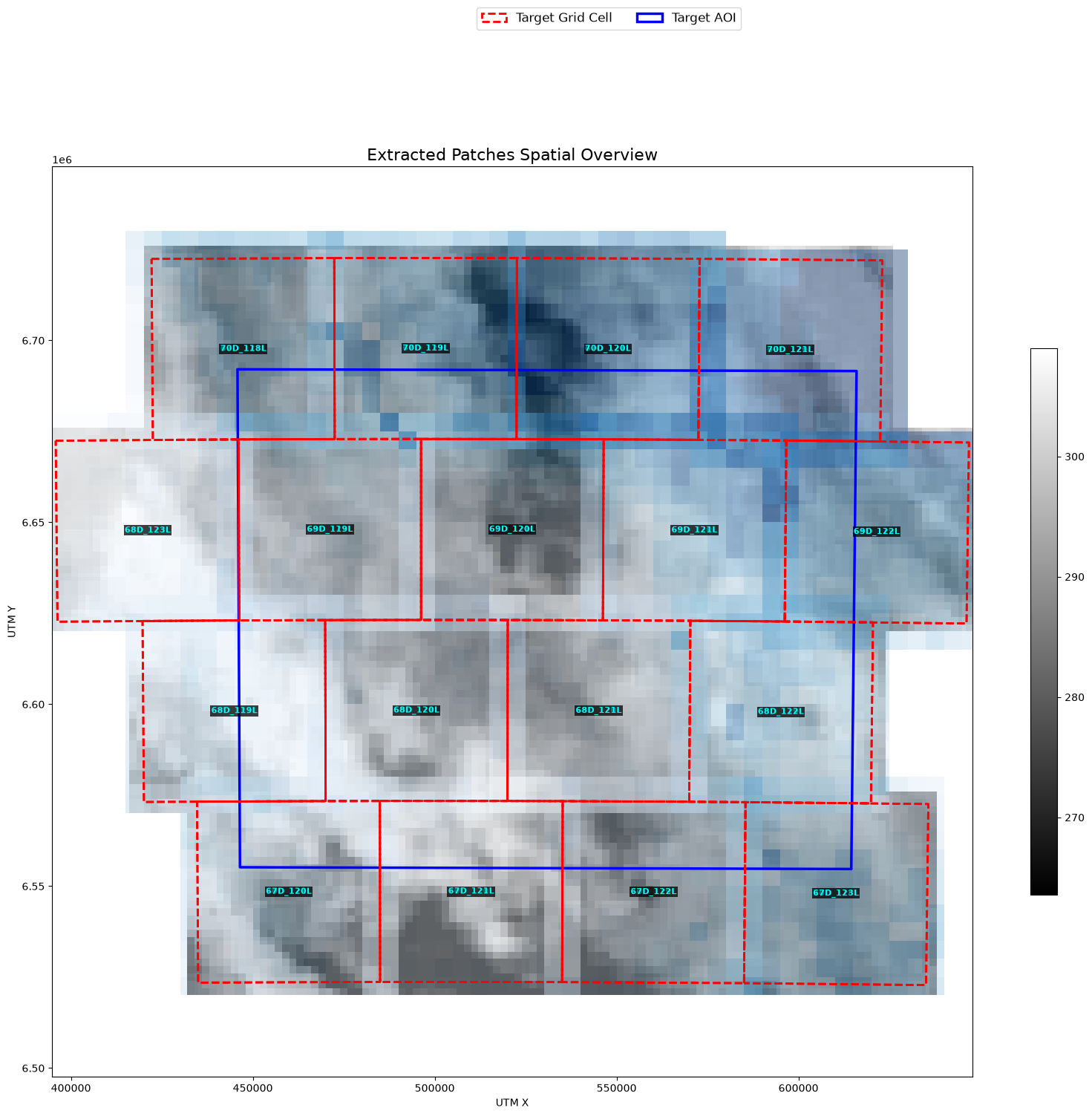
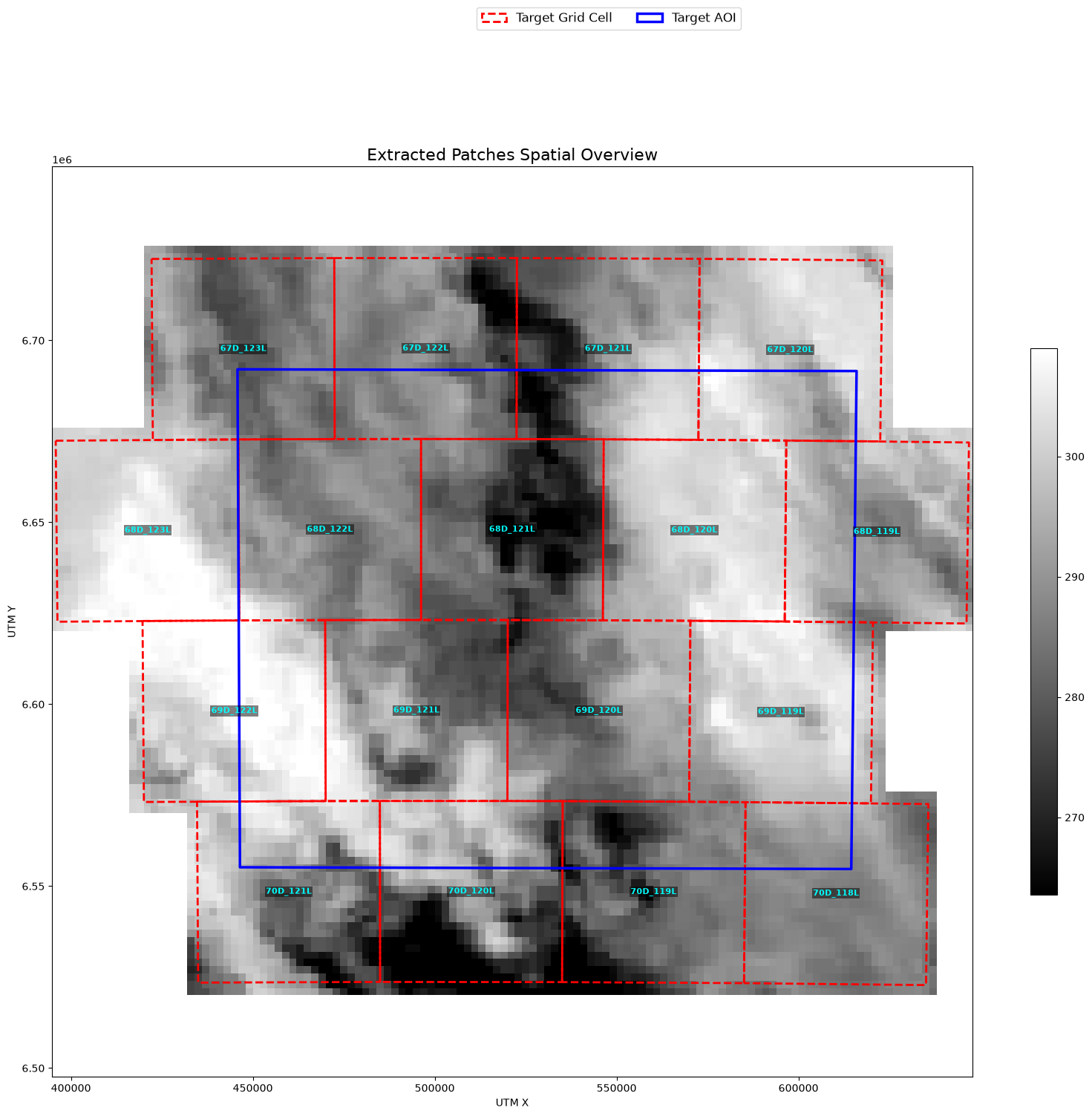
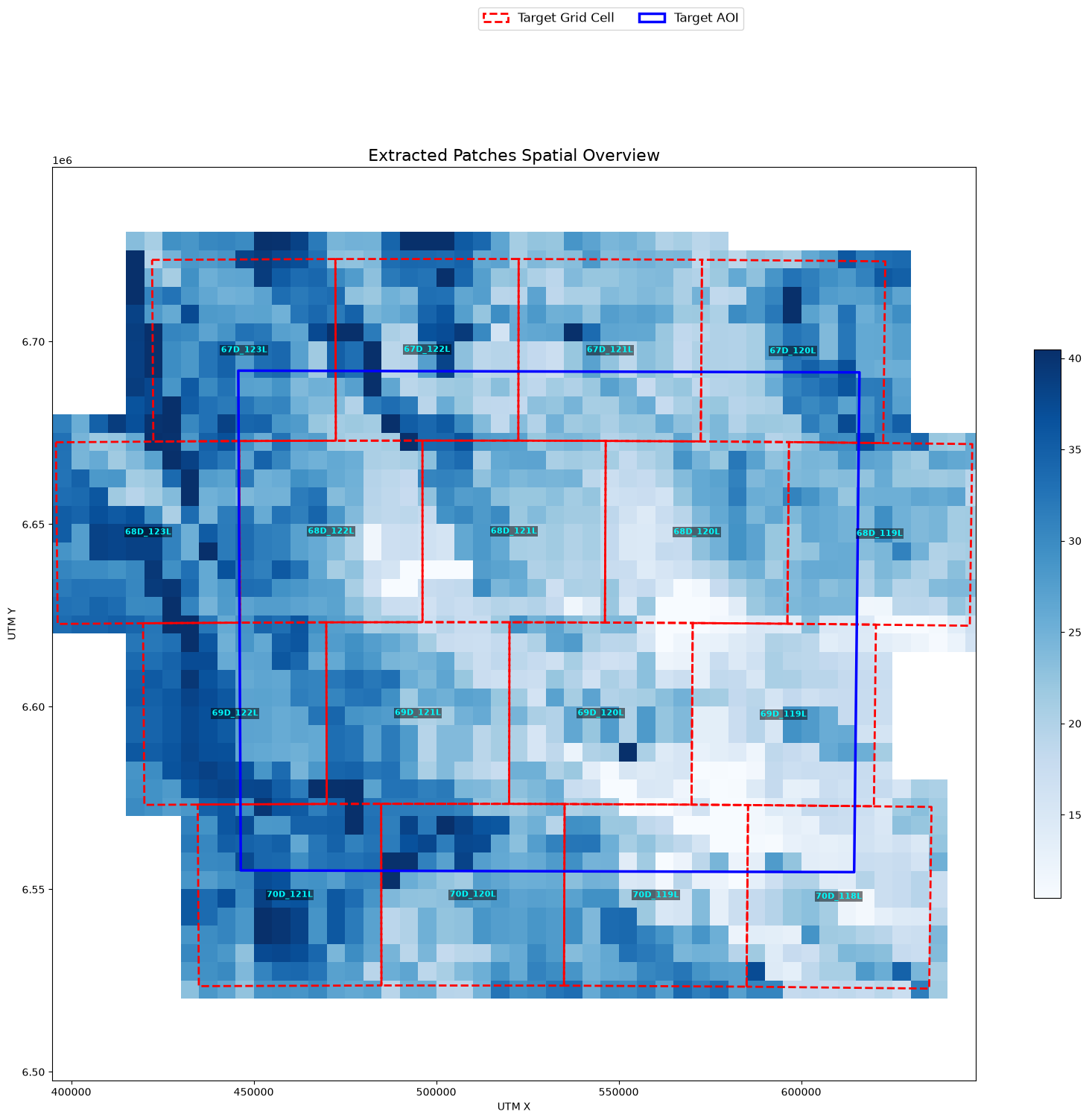
plot_artifact_patches stitches the per-cell artifacts back into the full scene. First GOES-19 C07, then CHIRPS precipitation for 2025-12-25 — a genuinely wet day.
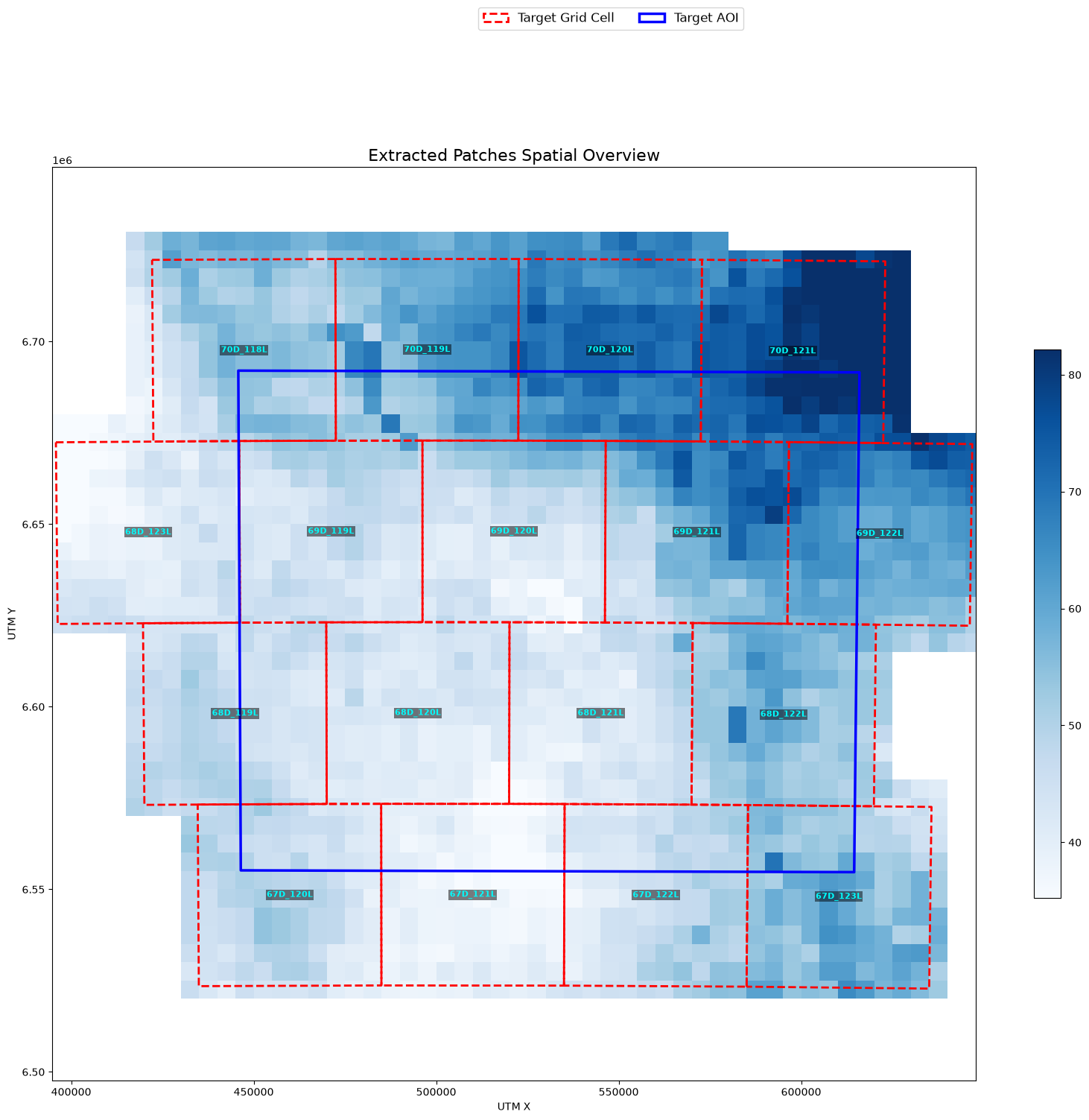
A note on “holes” in daily precipitation maps: they are almost never missing data (these CHIRPS rasters have 0% NaN). White is a real 0 mm — on any given day most of a region sees no rain. The informative view is an accumulation, which is what we build next.
from aereo.viz import plot_artifact_patches

fig, ax = plot_artifact_patches(
    goes_artifacts,
    ds_factor=1,
    stretch="percentile",
    cmap="gray",
    aoi=job_goes.target_aoi,
    aoi_edgecolor="blue",
)
Ignoring fixed y limits to fulfill fixed data aspect with adjustable data limits.
fig, ax = plot_artifact_patches(
    chirps_artifacts,
    ds_factor=1,
    stretch="percentile",
    cmap="Blues",
    aoi=job_chirps.target_aoi,
    aoi_edgecolor="blue",
)
Ignoring fixed y limits to fulfill fixed data aspect with adjustable data limits.
Filling the map: accumulate the week
Each day is already a separate row per cell in our index (identified by start_time), so accumulating is a per-cell sum across the referenced rasters. We write the accumulated rasters as derived products and point a small catalog at them — precipitation adds up, unlike temperature or reflectance, which you would average instead.
import os

import numpy as np
import rasterio

accum_dir = "/tmp/aereo_weather/chirps_accum"
os.makedirs(accum_dir, exist_ok=True)

accum_rows = []
for cell_id in common_cells:
    rows = cat_chirps[cat_chirps.grid_cell == cell_id].sort_values("start_time")
    arrs, profile = [], None
    for uri in dict.fromkeys(rows.uri):
        with rasterio.open(uri) as src:
            arrs.append(src.read(1).astype("float32"))
            profile = src.profile
    accum = np.nansum(np.stack(arrs), axis=0)  # weekly accumulation, mm
    out_uri = f"{accum_dir}/{cell_id}_week.tif"
    profile.update(count=1, dtype="float32", nodata=None)
    with rasterio.open(out_uri, "w", **profile) as dst:
        dst.write(accum, 1)
    row = rows.iloc[0].copy()
    row["uri"] = out_uri
    accum_rows.append(row)

accum_artifacts = gpd.GeoDataFrame(
    accum_rows,
    geometry=gpd.GeoSeries([r["geometry"] for r in accum_rows], crs=cat_chirps.crs),
)
# plot_artifact_patches needs cell_utm_footprint as a GeoSeries too
accum_artifacts["cell_utm_footprint"] = gpd.GeoSeries(
    accum_artifacts["cell_utm_footprint"].values,
    crs=f"EPSG:{accum_artifacts['cell_utm_crs'].iloc[0]}",
)
print(f"{len(accum_artifacts)} accumulated rasters in {accum_dir}")
17 accumulated rasters in /tmp/aereo_weather/chirps_accum
/tmp/ipykernel_207633/1913741027.py:15: DeprecationWarning: Setting the shape on a NumPy array has been deprecated in NumPy 2.5.
As an alternative, you can create a new view using np.reshape (with copy=False if needed).
  arrs.append(src.read(1).astype("float32"))
/tmp/ipykernel_207633/1913741027.py:15: DeprecationWarning: Setting the shape on a NumPy array has been deprecated in NumPy 2.5.
As an alternative, you can create a new view using np.reshape (with copy=False if needed).
  arrs.append(src.read(1).astype("float32"))
/tmp/ipykernel_207633/1913741027.py:15: DeprecationWarning: Setting the shape on a NumPy array has been deprecated in NumPy 2.5.
As an alternative, you can create a new view using np.reshape (with copy=False if needed).
  arrs.append(src.read(1).astype("float32"))
/tmp/ipykernel_207633/1913741027.py:15: DeprecationWarning: Setting the shape on a NumPy array has been deprecated in NumPy 2.5.
As an alternative, you can create a new view using np.reshape (with copy=False if needed).
  arrs.append(src.read(1).astype("float32"))
/tmp/ipykernel_207633/1913741027.py:15: DeprecationWarning: Setting the shape on a NumPy array has been deprecated in NumPy 2.5.
As an alternative, you can create a new view using np.reshape (with copy=False if needed).
  arrs.append(src.read(1).astype("float32"))
/tmp/ipykernel_207633/1913741027.py:15: DeprecationWarning: Setting the shape on a NumPy array has been deprecated in NumPy 2.5.
As an alternative, you can create a new view using np.reshape (with copy=False if needed).
  arrs.append(src.read(1).astype("float32"))
/tmp/ipykernel_207633/1913741027.py:15: DeprecationWarning: Setting the shape on a NumPy array has been deprecated in NumPy 2.5.
As an alternative, you can create a new view using np.reshape (with copy=False if needed).
  arrs.append(src.read(1).astype("float32"))
/tmp/ipykernel_207633/1913741027.py:15: DeprecationWarning: Setting the shape on a NumPy array has been deprecated in NumPy 2.5.
As an alternative, you can create a new view using np.reshape (with copy=False if needed).
  arrs.append(src.read(1).astype("float32"))
/tmp/ipykernel_207633/1913741027.py:15: DeprecationWarning: Setting the shape on a NumPy array has been deprecated in NumPy 2.5.
As an alternative, you can create a new view using np.reshape (with copy=False if needed).
  arrs.append(src.read(1).astype("float32"))
/tmp/ipykernel_207633/1913741027.py:15: DeprecationWarning: Setting the shape on a NumPy array has been deprecated in NumPy 2.5.
As an alternative, you can create a new view using np.reshape (with copy=False if needed).
  arrs.append(src.read(1).astype("float32"))
/tmp/ipykernel_207633/1913741027.py:15: DeprecationWarning: Setting the shape on a NumPy array has been deprecated in NumPy 2.5.
As an alternative, you can create a new view using np.reshape (with copy=False if needed).
  arrs.append(src.read(1).astype("float32"))
/tmp/ipykernel_207633/1913741027.py:15: DeprecationWarning: Setting the shape on a NumPy array has been deprecated in NumPy 2.5.
As an alternative, you can create a new view using np.reshape (with copy=False if needed).
  arrs.append(src.read(1).astype("float32"))
/tmp/ipykernel_207633/1913741027.py:15: DeprecationWarning: Setting the shape on a NumPy array has been deprecated in NumPy 2.5.
As an alternative, you can create a new view using np.reshape (with copy=False if needed).
  arrs.append(src.read(1).astype("float32"))
/tmp/ipykernel_207633/1913741027.py:15: DeprecationWarning: Setting the shape on a NumPy array has been deprecated in NumPy 2.5.
As an alternative, you can create a new view using np.reshape (with copy=False if needed).
  arrs.append(src.read(1).astype("float32"))
/tmp/ipykernel_207633/1913741027.py:15: DeprecationWarning: Setting the shape on a NumPy array has been deprecated in NumPy 2.5.
As an alternative, you can create a new view using np.reshape (with copy=False if needed).
  arrs.append(src.read(1).astype("float32"))
/tmp/ipykernel_207633/1913741027.py:15: DeprecationWarning: Setting the shape on a NumPy array has been deprecated in NumPy 2.5.
As an alternative, you can create a new view using np.reshape (with copy=False if needed).
  arrs.append(src.read(1).astype("float32"))
/tmp/ipykernel_207633/1913741027.py:15: DeprecationWarning: Setting the shape on a NumPy array has been deprecated in NumPy 2.5.
As an alternative, you can create a new view using np.reshape (with copy=False if needed).
  arrs.append(src.read(1).astype("float32"))
fig, ax = plot_artifact_patches(
    accum_artifacts,
    ds_factor=1,
    stretch="percentile",
    cmap="Blues",
    aoi=job_chirps.target_aoi,
    aoi_edgecolor="blue",
)
Ignoring fixed y limits to fulfill fixed data aspect with adjustable data limits.
# Overlay: GOES-19 C07 as base, weekly CHIRPS accumulation on top.
fig, ax = plot_artifact_patches(
    goes_artifacts,
    ds_factor=1,
    stretch="percentile",
    cmap="gray",
    aoi=job_goes.target_aoi,
    aoi_edgecolor="blue",
)
fig, ax = plot_artifact_patches(
    accum_artifacts, ds_factor=1, stretch="percentile", cmap="Blues", ax=ax, alpha=0.4
)
Ignoring fixed y limits to fulfill fixed data aspect with adjustable data limits.