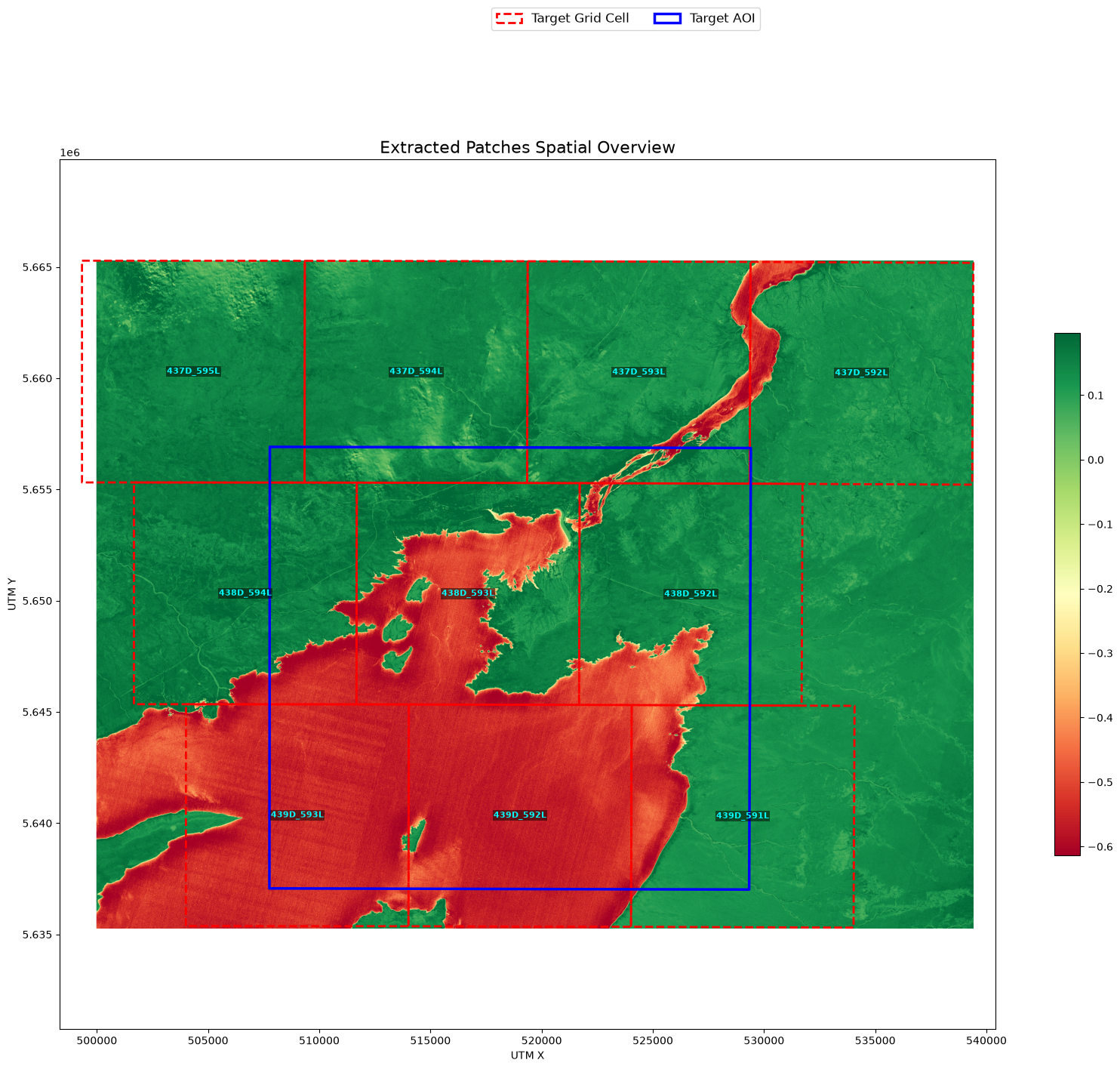
This chapter extends the Sentinel-2 L2A pipeline by computing the Normalized Difference Vegetation Index (NDVI) as a preprocessing step.
Sentinel-2 provides both bands at 10 m resolution, so the index can be computed directly from the L2A surface reflectance product without resampling.
Environment setup
The first cell installs AerEO and any required plugins. If you are reading the rendered book or running on Binder, where the environment is already prepared, pip will report that the requirements are satisfied and skip the download.
# Install AerEO and any required plugins for this notebook (Google Colab)
!pip install -q "aereo[viz]"
Config used in this notebook
This notebook loads the job from config/job_sentinel2-ndvi.yaml. It uses Hydra composition to extend job_sentinel2.yaml and only adds an NDVI preprocess stage:
defaults:
  - job_sentinel2
  - _self_

name: sentinel2_ndvi
preprocess:
  - _target_: aereo.builtins.ndvi
    _partial_: true
    ndvi_nir_band: nir
    ndvi_red_band: red
The defaults list tells Hydra to merge job_sentinel2.yaml first, then apply the overrides in this file. This lets you define one base sensor config and create many derived products with only a few lines of YAML.
# Download config files and AOIs from the GitHub repository so this
# notebook can run outside the repo (e.g. Google Colab).
import os
import urllib.request

GITHUB_RAW = "https://raw.githubusercontent.com/frandorr/aereo/main"

os.makedirs("config/aoi", exist_ok=True)

# Config files
urllib.request.urlretrieve(
    f"{GITHUB_RAW}/examples/config/job_sentinel2.yaml",
    "config/job_sentinel2.yaml",
)
urllib.request.urlretrieve(
    f"{GITHUB_RAW}/examples/config/job_sentinel2-ndvi.yaml",
    "config/job_sentinel2-ndvi.yaml",
)

# AOI files
urllib.request.urlretrieve(
    f"{GITHUB_RAW}/examples/config/aoi/chocon.geojson",
    "config/aoi/chocon.geojson",
)
Loading the job
ExtractionJob.load_from_config() parses the YAML with Hydra, resolves every _target_ callable, and validates the resulting ExtractionJob. The config_name argument is the YAML filename without extension, and config_dir is the folder that contains it.
A job is a declarative bundle of pipeline steps. Once loaded, the same job can be searched, can have tasks built from it, and can be executed.
from aereo.cache import TaskResultCache
from aereo.executors import LocalExecutor
from aereo.pipeline import ExtractionJob

# Load the job from the Hydra config package.
job = ExtractionJob.load_from_config(
    config_dir="config",
    config_name="job_sentinel2-ndvi",
)
assets = job.search()  # Use the search method from the job object to get the assets.
tasks = job.build_tasks(assets)
len(tasks)
2026-07-08 14:48:07 [info ] search_called provider=search_stac
2026-07-08 14:48:09 [info ] build_tasks_start assets=16 builder=build_grouped_tasks
8The executor
AerEO separates what to run (the tasks) from how to run them. LocalExecutor runs tasks on the local machine. The workers argument controls parallelism, and use_threads=True uses a threading backend, which is a good default for I/O-bound COG readers.
# now we create an Executor, in this case a LocalExecutor to run
# each ExtractionTask using Threads
local_exec = LocalExecutor(workers=-1, use_threads=True, cache=TaskResultCache())
Running the extraction
job.execute(tasks, executor=...) hands the prepared tasks to the executor. The executor runs each task independently; inside every task AerEO performs the pipeline:
read -> preprocess -> reproject -> postprocess -> writeThe returned object is a GeoDataFrame of artifacts — one row per output GeoTIFF with its metadata, CRS, and footprint.
# Extract!
print("Extracting...")
artifacts = job.execute(tasks, executor=local_exec)
print(f"✓ Extracted {len(artifacts)} artifacts")
Extracting...
2026-07-08 14:48:09 [info ] execute_start executor=LocalExecutor task_count=8
✓ Extracted 56 artifacts
Visualizing NDVI
plot_artifact_patches is called with the RdYlGn colormap, a common choice for vegetation indices: red for low NDVI (water, shadows, bare soil), yellow for sparse vegetation, and green for healthy vegetation.
from aereo.viz import plot_artifact_patches

plot_artifact_patches(
    artifacts,
    ds_factor=1,
    cmap="RdYlGn",
    stretch="percentile",
    aoi=job.target_aoi,
    aoi_edgecolor="blue",
)
(<Figure size 2000x1495.93 with 2 Axes>,
<Axes: title={'center': 'Extracted Patches Spatial Overview'}, xlabel='UTM X', ylabel='UTM Y'>)Ignoring fixed y limits to fulfill fixed data aspect with adjustable data limits.